Warning: Use of undefined constant wpurl - assumed 'wpurl' (this will throw an Error in a future version of PHP) in /home/y9gq09f5yym1/public_html/wp-content/plugins/add-to-facebook-plugin/addtofacebook.php on line 50
Cereal is still an occasional snack for me, but when I was a little kid, it was one of my major sources of nutrition. And among all foods items, it is one of the most lucrative, competitive and high margin areas. Cereals have added fiber, low calories and whole grains as a response to the health-food movement’s criticism (Childhood Obesity campaign, etc.).
One thing that has not gone out of style is the packaging – advertising – and the prize inside, music.
60s –
7 songs on 4 different boxes
45 singles/eps that could be played a few times
cut out of box and hopefully not warped or skipping
possibly no plastic liner to keep cereal in after cutting box
no upc code
preservatives, no fiber, real sugar, no calorie count but ingredients listed
Sixties Alpha-Bits and Honey Comb Archies Commercial
Warning: Use of undefined constant wpurl - assumed 'wpurl' (this will throw an Error in a future version of PHP) in /home/y9gq09f5yym1/public_html/wp-content/plugins/add-to-facebook-plugin/addtofacebook.php on line 50
This excellent commercial just caught my eye but it’s probably been out for months. The announcer growls a spiel about the Chrysler 300 over an instrumental version of “Heart of the City,” one of the most sublime backing tracks ever, as the car makes its way from downtown out to the ‘burbs. Even if Jay-Z doesn’t appear in the ad, it’s hard to dissociate this music from him for us fans.
Damn, America sure has come a long way in terms of its music taste and sensitivity to inner city/suburban cultural and economic disparities. I just hope we can restore some love to downtown Detroit someday soon. “Pride you can notice from down the street” is what Chrysler promises. What if there is no street?
I love the tempo/chord changes that shift the mood of the song back and forth from an outspoken tone to a more reflective one. In the commercial, this is used to delineate between the urban grit and suburban sunshine. Well done!
Warning: Use of undefined constant wpurl - assumed 'wpurl' (this will throw an Error in a future version of PHP) in /home/y9gq09f5yym1/public_html/wp-content/plugins/add-to-facebook-plugin/addtofacebook.php on line 50
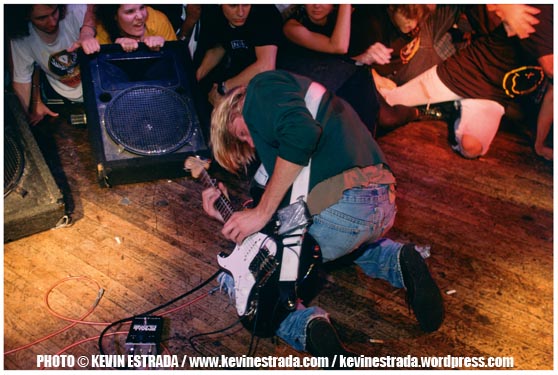
Thanks to Kevin Estrada for use of this picture! Note black and yellow DGC promo shirt at right
Twenty years ago this week, Nirvana was in the midst of making history even while preparing to unleash their single “Smells Like Teen Spirit” and the album Nevermind on the world. As college and metal radio promotion person for DGC Records, I had spent the week like any other: adds and rotations on Monday and Tuesday, followed by a marketing meeting and conference call with the field staff. Wednesday through Friday of this week would be spent with Nirvana in town to launch the promotion campaign around their DGC debut.
Warning: Use of undefined constant wpurl - assumed 'wpurl' (this will throw an Error in a future version of PHP) in /home/y9gq09f5yym1/public_html/wp-content/plugins/add-to-facebook-plugin/addtofacebook.php on line 50
In a promotional push for his new album Drums Between the Bells with Rick Holland, Brian Eno has embarked on a great public relations swing that has brought a typically educational and thought-provoking set of ideas from One Brain. The interview on Al-Jazeera shown below, includes a great career overview too. Eno comments on the current state of the industry, his own history and the “recent resurgence in live music.”
“I always assumed I was going to be a painter, and I realized that what you could do with sound that were quite analogous to what a painter would do with color… so I started to form this idea of being a “sound painter,” and synthesizers of course played right into that. Synthesizers were instruments that really had no history, so it made perfect sense for a musician who couldn’t play anything. It was an instrument no one else could play them either.”
He discusses childhood listening to “martian music” his sister acquired for him at the US Army base near their home and his parents’ influence on his ability to sing and perform in public.
On his career ambitions in the 60s: “I always assumed I would become an art teacher. We never had any career advisors…” I’d say that assumption came true. Incredible to hear about his entry and descriptions of Roxy Music and his role in the band. As the interviewer mentions, “you like to shoot journalists who ask about Roxy Music.”
He goes on to discuss the origin of Ambient Music, his influences Phil Spector (music as product of studio), Steve Reich and the Velvet Underground (kinship with the band’s arty and non-musical background).
Warning: Use of undefined constant wpurl - assumed 'wpurl' (this will throw an Error in a future version of PHP) in /home/y9gq09f5yym1/public_html/wp-content/plugins/add-to-facebook-plugin/addtofacebook.php on line 50
Live Aid was held on July 13, 1985
Today is the anniversary of Live Aid, the historic benefit concert for African famine relief that occurred in London and Philadelphia in 1985. I watched the whole thing, calling in sick to my job doing flower deliveries. The event was carried on broadcast television in addition to MTV, which is why I was able to see it, and was treated like a telethon as much as a festival. Casey Kasem, who was not usually an MTV veejay, served as host and reminded fans at every commercial break “Live Aid – we’re coming together.” With the live satellite broadcast and even one performer playing on both shows, it really felt like the world got smaller that day.
Live Aid was part of the momentum initiated by Bob Geldof and Midge Ure’s benefit single under the name Band Aid, “Do They Know It’s Christmas (Feed the World),” a very good song with the cream of British pop at the time. Artists like Sting, Bono and Annie Lennox were just getting their political identities going at this point, and their participation added poignancy to their own music. It was a well-made record too, despite coming together quickly. Not to be outdone, Quincy Jones, Michael Jackson and Lionel Richie soon collaborated to write and record “We are the World.”
Once the concert was announced, tickets were gone. Led Zeppelin was to reunite in Philadelphia, and they could have sold out JFK themselves. As the show started in London, one of the first artists, U2, stole the show, proving their anthemic rock was ready for stadiums. Bono gave Freddy Mercury, David Bowie and other megas a kick in the ass that day. Phil Collins personally broke bottled water, previously considered a waste of money a big boost by appearing in every interview with a bottle of Evian (naive spelled backwards we said at the time).